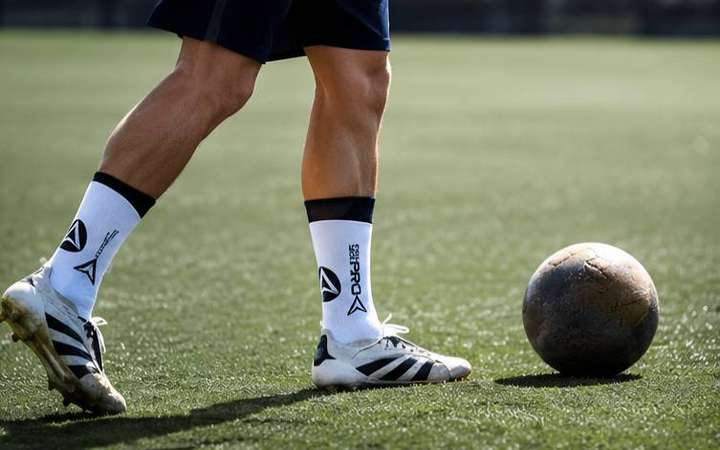
Watch any professional match and look at the players’ legs: holes in the back of the calves, team socks that stop at the ankle, a different sock showing above the boot. It looks odd the first time. There are two good reasons for it.
Cut around the calf to relieve pressure
Team socks are long and, on many players, tight around the calf. A tight band over a muscle that works for 90 minutes is uncomfortable, and some players feel it restricts them. Cutting one, two or more small holes at the back of the calf releases the pressure without changing how the sock looks from the front.
This is a comfort choice. Players who do it say their calves feel freer, and some believe the relief also makes cramp less likely.
If your socks do not bother you, there is no need to do it.
Cut off the foot to wear their own grip socks
Team socks are part of the kit and carry the club colours, but most are a long, smooth tube with a basic foot. They hold the shin guard, but they are not designed to grip inside the boot. In recent years team socks have turned into sleeves: many are now supplied as part of the kit without the foot, for exactly this reason.
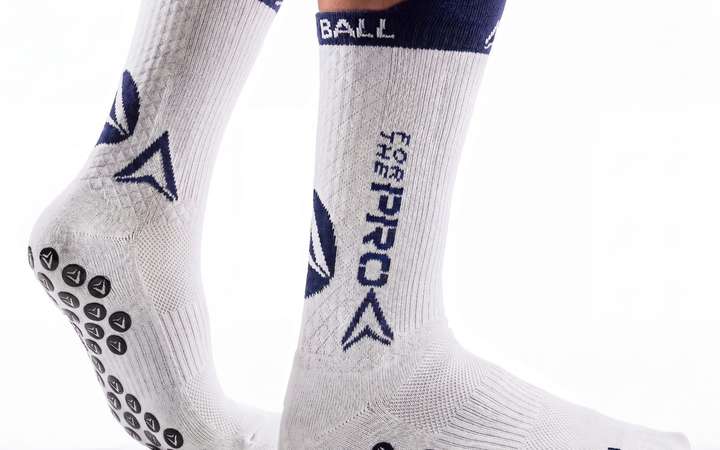
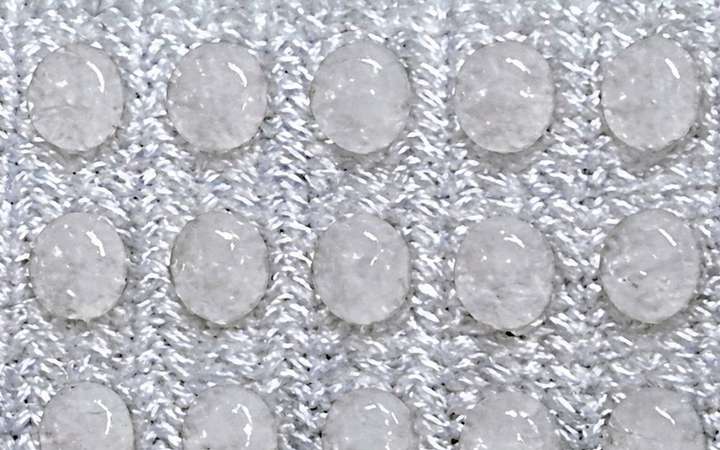
Professionals want a grip sock on their foot: a short, close-fitting sock with grip pads on the sole that stops the foot sliding inside the boot. (If you have not used one, here is what grip socks are and how they work.) To wear one without giving up the team socks, they cut the foot off the team sock and use the rest as a sleeve.
The result:
- Grip sock on the foot, inside the boot.
- Shin guard on the shin.
- Cut team sock pulled over the shin guard as a sleeve, overlapping the top of the grip sock. Sometimes team socks are already supplied as sleeves.
From the stands it looks like one sock. Inside the boot it is a different piece of kit.
How to cut your football socks
You need sharp scissors and two minutes. For the grip-sock setup:
- Put the team sock on and mark a point about two fingers above your ankle bone.
- Take it off and cut straight across at the mark, through both layers.
- Pull the sleeve on over your shin guard, then check that it overlaps the top of your grip sock by a few centimetres.
For calf holes:
- Pinch a small fold of fabric at the back of the calf, where it feels tightest.
- Cut a small slit through the fold, starting small: you can always make it bigger.
- Repeat lower down if you want more relief.
If you would rather not cut your club socks, footless sleeves in team colours do the same job.
What the rules say
Law 4 of the Laws of the Game lists socks as compulsory equipment and says that tape or any material applied or worn on the outside must be the same colour as the part of the sock it covers. It does not forbid cutting socks, and professional teams do it every week.
The part to watch is colour. If your grip sock shows between the boot and the sleeve, it is safest when it matches the sock colour. White grip socks blend in with white kits; for other colours, check what your league allows.
The grip sock is the part that matters
Cutting the team sock is only half the setup. The other half, the sock that is actually on your foot, decides how well the boot holds you. Look for grip pads under the ball of the foot and the heel, a close fit with no folds, and breathable fabric. Our guide to choosing grip socks goes through all seven points.
FOR THE PRO grip socks are built for exactly this setup: a short, white or blue grip sock to wear under your cut team socks, with grip zones on the sole, an internal grip system at the ankle, and an anatomical fit. Three designs, one size for EU 41 to 45. See the football grip socks.